
Why Most Life Sciences Companies Are Positioned to Sound Exactly Like Their Competitors
The Sameness Problem
Here's a test worth running right now. Go to your website, remove your logo, and read your homepage as if you've never heard of your company. Then do the same for your three closest competitors.
If the pages are interchangeable — and in most cases they will be — you have a positioning problem. Not a writing problem, not a design problem. A positioning problem. And it's one of the most commercially costly issues a life sciences company can have, because when buyers can't differentiate between vendors, decisions slow down, sales cycles lengthen, and price becomes the deciding factor.
This is happening across the industry right now, and it's not for lack of capability. Most life sciences companies have genuinely differentiated products, real scientific innovation, and meaningful results to point to. The problem is that their positioning doesn't reflect any of it.
The Category Trap
The most common positioning failure in life sciences has a name: the category trap. It works like this.
A company defines its market category — lab equipment, CRO services, genomics platforms, medical device — and then builds its positioning around the attributes that define that category. Speed. Scalability. Accuracy. Flexibility. Global reach. Scientific expertise. These are the things every company in the category claims, because they're the baseline requirements for competing in it at all.
The result is positioning that is technically accurate and completely undifferentiated. Every vendor in the category is faster, smarter, more scalable, and more flexible than the alternative. Every one of them has deep scientific expertise and a global footprint. None of those claims give a buyer a reason to choose one over another.
The category trap is seductive because it feels safe. Claiming what the category claims means you're unlikely to say anything wrong. But in positioning, safety is the enemy of differentiation. The companies that win aren't the ones that describe the category most accurately. They're the ones that stake out a specific, defensible position within it — or adjacent to it — that competitors can't easily replicate.
Why This Keeps Happening
Understanding the category trap is one thing. Understanding why smart companies keep falling into it is another.
In my experience, the most common cause is an over-reliance on internal perspective. Positioning developed by looking inward at what the company believes makes it great, what the founding team is proud of, what the product roadmap prioritizes, produces positioning that resonates internally and lands flat externally. What your organization values about itself is rarely what your buyers value about you.
Competitive benchmarking compounds the problem. Many companies build their positioning by studying competitors and trying to match or exceed their claims. The logical outcome of this approach is convergence: everyone ends up saying approximately the same things because everyone is reacting to everyone else. Positioning built through comparison produces positioning that sounds like the category, not like a company with a specific, defensible point of view.
The third cause is the absence of difficult choices. Strong positioning requires saying no. It requires choosing a specific audience, a specific problem, and a specific way of solving it — and accepting that this choice means some buyers won't immediately see themselves in your story. Most organizations find that degree of specificity uncomfortable, particularly when leadership is concerned about leaving revenue on the table. The result is positioning that tries to speak to everyone and resonates with no one.
What Differentiated Positioning Actually Requires
Real differentiation in life sciences positioning starts with one question that most companies haven't answered rigorously: why do customers actually choose you, as opposed to why do you think they choose you?
These are different questions, and the answers are almost always different. The features your product team is most proud of are frequently not the factors that drove a buyer's decision. The capabilities your marketing team emphasizes
are often not the ones that came up in the sales conversation that closed the deal. The positioning you've built around your technology may be less important to buyers than the way your team shows up during implementation.
The only way to find out is to ask. Win/loss interviews, voice of customer research, and structured conversations with existing customers about their decision process will surface the real reasons people choose you. Those reasons — specific, buyer-validated, and grounded in actual purchase decisions — are the raw material of differentiated positioning.
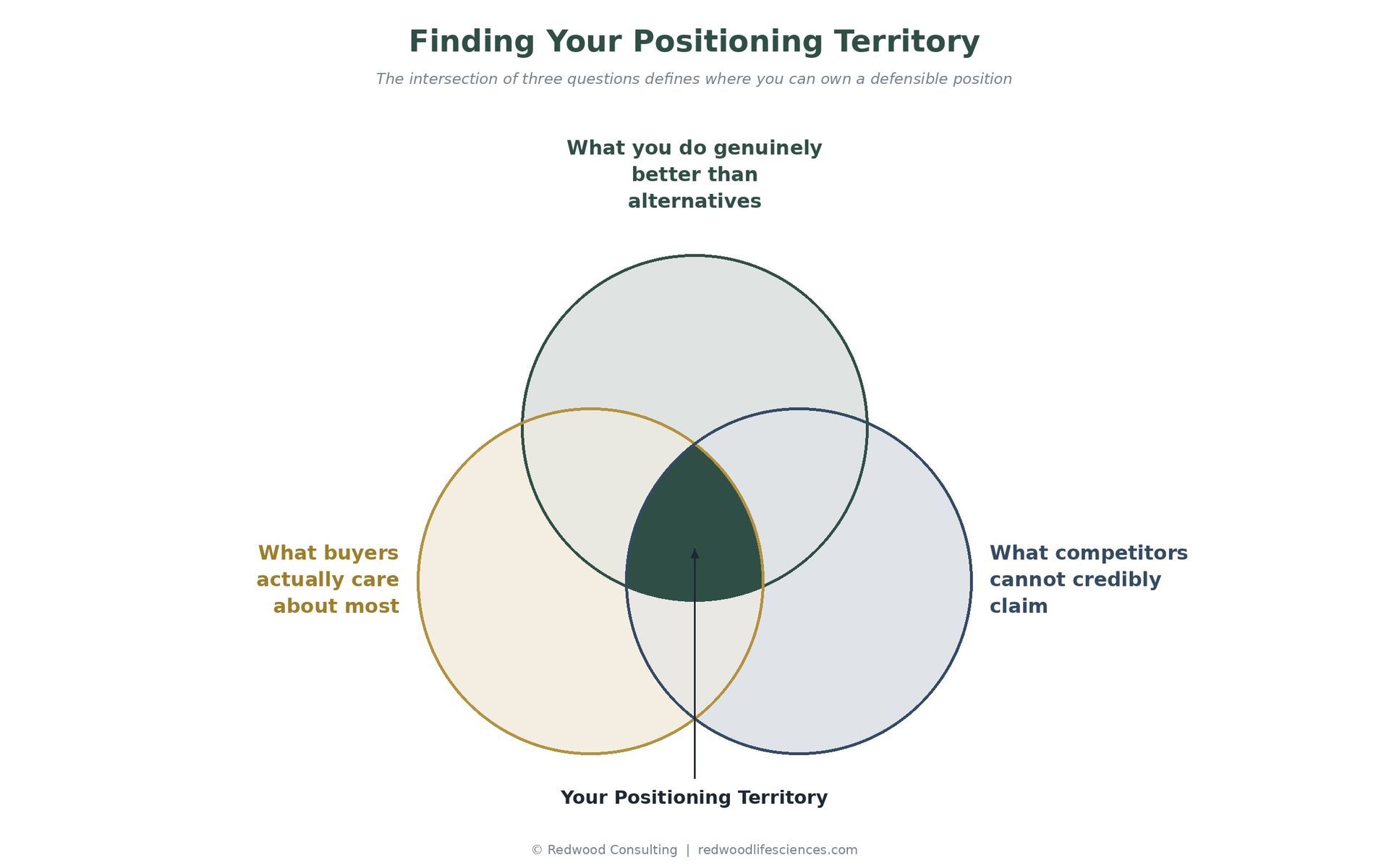
What you're looking for is the intersection of three things: what you do genuinely better than alternatives, what buyers actually care about at the moments that matter most in their evaluation, and what competitors cannot credibly claim. That intersection is your positioning territory. Everything outside it is either undifferentiated or unsustainable.
The Messaging Architecture That Brings Positioning to Life
Positioning is a strategic choice. Messaging is how that choice gets expressed across every buyer-facing surface. The gap between the two is where most life sciences companies lose the thread.
A positioning statement — however well-crafted — doesn't drive content, sales conversations, or campaign copy on its own. What's needed is a messaging architecture: a structured framework that translates the positioning into specific messages for specific audiences at specific stages of their evaluation.
In practice, this means defining the core value proposition that applies across your full audience, then layering persona-specific messages that address the specific concerns of each buying committee member. The scientific evaluator needs a different expression of your positioning than the economic buyer, who needs a different expression than the procurement stakeholder. The underlying positioning is consistent. The way it's communicated adapts to who's listening and what they care about.
This is why positioning and messaging work done in isolation from the buying committee (built for a single, generic customer) produces materials that resonate with nobody in particular. A messaging architecture built around a real buying committee, grounded in real buyer intelligence, produces content that moves specific people forward at specific moments in their evaluation.
The AI Dimension
There's a new urgency to getting positioning right that didn't exist a few years ago. Multiple research sources now confirm that AI tools have fundamentally changed how B2B buyers discover and evaluate vendors. A March 2026 analysis of 680 million AI citations found that 73% of B2B buyers now use AI tools like ChatGPT and Perplexity in their research process. Forrester's 2025 survey of more than 4,000 buyers found that 61% of the buying journey completes before the buyer contacts a vendor — a figure that rises further when AI tools are providing synthesized competitive comparisons.* In practical terms, this means a buyer may have already formed a view of your positioning, your competitors, and your relative strengths before anyone on your team knows they exist.
This changes the stakes of positioning in a specific way. When a buyer asks an AI tool to compare vendors in your category, the AI synthesizes an answer from whatever is publicly available about each company: website content, third-party mentions, published materials, industry coverage. If your positioning is generic and your messaging sounds like the category, that's what gets synthesized. If your positioning is specific, credible, and consistently expressed across your digital presence, that's what gets surfaced.
In the answer engine era, your positioning isn't just what you say to buyers directly. It's what AI systems learn to say about you when buyers aren't talking to you at all. Generic positioning that blends into the category doesn't just fail in sales conversations — it fails to register in the AI-mediated discovery process that increasingly precedes those conversations.
A Practical Starting Point
Repositioning a life sciences brand is not a small undertaking. But getting started doesn't require a full strategic overhaul. A few focused moves will tell you quickly whether your current positioning is working and where the gaps are.
Run the homepage test described at the start of this post, but do it systematically. Pull the homepages of your five closest competitors and yours. Strip the logos. Read them as a buyer would. Note every phrase that appears on more than two pages; those are typically category claims, not differentiators. What's left, if anything, is your actual positioning territory.
Talk to three customers who chose you over a competitor in the last twelve months. Ask them specifically what tipped the decision. Not what they valued about your product generally, but what made them choose you at the moment of decision. The answers will likely surprise you and will almost certainly point to something more specific than what your current positioning emphasizes.
Ask your sales team which messages land and which ones don't. Which claims generate follow-up questions and engagement? Which ones get a polite nod and no response? Sales conversations are the most honest real-time test of whether positioning is resonating, and most marketing teams don't tap that intelligence systematically.
Then make a choice. Pick the most specific, defensible, buyer-validated position you can occupy and build your messaging architecture around it. Resist the temptation to hedge with qualifiers and additional claims that dilute the specificity. The goal is a position that some buyers will find immediately compelling and others won't immediately recognize themselves in. That's not a failure of positioning. That's how positioning is supposed to work.
The Commercial Case
Positioning isn't a branding exercise. It's a commercial lever, and the commercial consequences of weak positioning are real and measurable.
When buyers can't differentiate between vendors, they slow down. They add more evaluation steps, bring in more stakeholders, and extend the sales cycle trying to find a basis for decision. When they still can't differentiate, they default to price. Deals that should close on value close on discount, and margins compress accordingly.
Strong positioning does the opposite. It gives buyers a clear, credible reason to prefer you before the sales conversation begins. It shortens the evaluation process because the differentiation is already established. It reduces price sensitivity because buyers who understand specifically why you're the right choice are less likely to treat the decision as a commodity.
In a market where most companies sound like their competitors, clear and specific positioning is one of the few remaining sources of durable competitive advantage. It's also one of the most underinvested.
I work with life sciences companies on digital marketing strategy, from SEO/AEO and content to demand generation, positioning and messaging, omnichannel campaigns, product launches, voice of customer, and more. If this resonated, or if you have a different perspective, I'd genuinely like to hear from you.
*Sources
Loganix. 2026 B2B AI Buying Behavior Analysis. April 3, 2026. Based on a multi-source synthesis of six independently published studies conducted between October 2025 and March 2026, covering 680 million AI citations, 2,961 controlled research sessions, and 1.96 million browsing sessions across ChatGPT, Perplexity, Gemini, and Google AI Overviews. https://www.prnewswire.com/news-releases/73-of-b2b-buyers-use-ai-tools-in-purchase-research-multi-source-analysis-finds-302733319.html
Forrester Research. B2B Buyer Survey. 2025. Survey of 4,000+ business buyers examining the B2B buying journey and vendor contact behavior.