
The Content Strategy Gap, Part 3: What a Sophisticated Persona-Based Content Strategy Actually Looks Like
This is Part 3 of a three-part series on building a content strategy that actually works in life sciences B2B. Part 1 examined why these strategies fail before they start. Part 2 explored why the buying committee gets lopsided content coverage. This post shows what it looks like when it's built right.
From Diagnosis to Solution
The first two posts in this series diagnosed the problem. Persona-based content strategies fail because they're treated as projects rather than systems, and because the buying committee rarely gets equal content coverage. The technical evaluator is well served. Everyone else — the economic buyer, procurement, IT, the executive sponsor — is largely left to fend for themselves, with predictable consequences for pipeline and deal velocity.
This post is about what the solution actually looks like in practice. Not as a theoretical framework, but as a working model that a life sciences company can build, sustain, and compound over time. It requires more organizational discipline than most teams expect. The pipeline outcomes it produces justify that investment many times over
Start With Real Buyer Intelligence, Not Assumptions
Every content strategy is only as good as its understanding of the buyer. And most content strategies are built on assumptions — internal beliefs about what buyers care about, what questions they ask, and what content influences their decisions — rather than on what buyers have actually said.
The starting point for a sophisticated content strategy is voice of customer research: structured conversations with recent buyers, recently lost prospects, and existing customers about their actual buying experience. Not about your product, but about their process. What triggered the evaluation? What questions did they have at each stage? Where did they look for information, and increasingly, what did they ask AI tools like ChatGPT or Perplexity, and did your brand appear in those answers? What content did they encounter that was useful? What would have made their evaluation easier or faster? What almost derailed the deal?
The answers are almost always surprising and almost always specific. A lab automation buyer might tell you that the piece of content that most influenced their decision was a third-party validation study they found through a peer recommendation, not anything on your website. A procurement stakeholder might tell you that they spent three weeks trying to find your vendor compliance documentation and almost pulled you from consideration because they couldn't. An economic buyer might tell you that nobody ever gave them a clear answer to the total cost of ownership question, and they had to piece it together from multiple conversations and documents.
This intelligence, gathered directly from the people who have lived the buying journey, is what separates a content strategy built on insight from one built on assumption. It also produces immediate, actionable content briefs: every gap a buyer names is a content opportunity.
Supplement VOC interviews with what's already available internally. Sales call recordings, win/loss analysis, CRM notes from closed and lost deals — these are rich sources of buyer intelligence that most marketing teams don't systematically mine. A few hours reviewing recent call recordings with a specific focus on the questions buyers asked and the concerns they raised will surface more actionable content direction than most formal persona workshops.
Build the Messaging Matrix
Once the buyer intelligence is assembled, the next step is organizing it into a structure that drives content creation systematically. The tool for this is a messaging matrix.
A messaging matrix is a framework that maps specific messages to specific personas at specific buying stages. Think of it as a grid: buying stages run across the horizontal axis (awareness, consideration, evaluation, decision, post-purchase), and buying committee personas run down the vertical axis (technical evaluator, economic buyer, procurement, IT stakeholder, executive sponsor). Each cell in the grid represents the intersection of one persona and one buying stage.
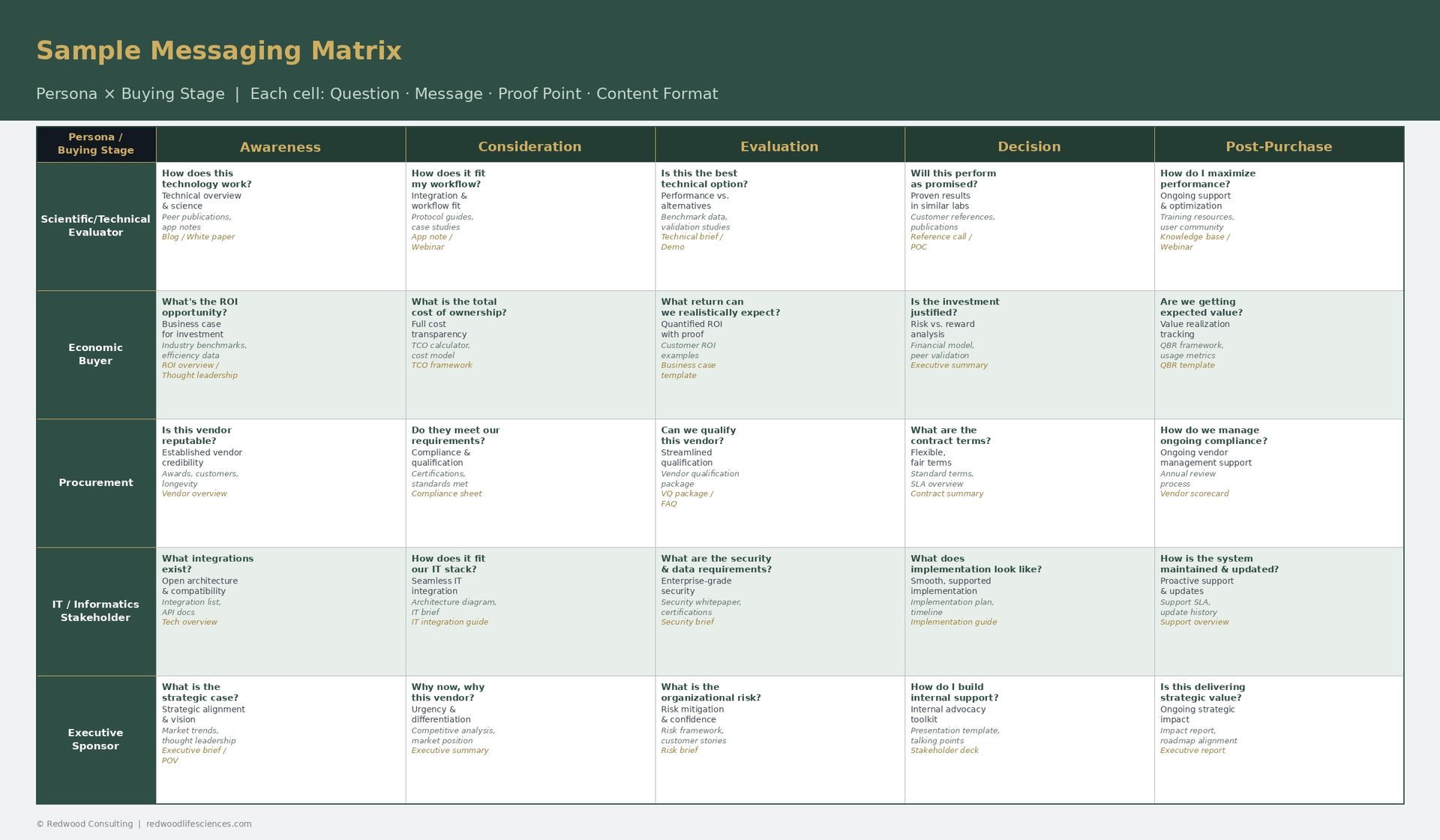
For each cell, the messaging matrix captures four things: the primary question this persona is asking at this stage, the key message that addresses it, the proof point that makes that message credible, and the content format that delivers it most effectively to this persona at this stage.
The power of the messaging matrix is that it makes content gaps visible in a way that a content calendar or a topic list never can. When you look at the grid and see that the economic buyer row is almost entirely empty at the consideration and evaluation stages, you know exactly where to invest next. When you see that the procurement row has no content at any stage, you know why deals are stalling. The matrix translates buyer intelligence into editorial direction.
It also creates alignment. When sales, marketing leadership, and the content team all share the same messaging matrix, there's a common framework for prioritizing content investment, evaluating new content ideas, and measuring whether the content library is actually serving the buying committee. Decisions that used to be subjective become answerable by reference to the matrix.
An Illustrative Example
To make this concrete, consider a composite scenario drawn from the kinds of engagements common in life sciences B2B: a mid-size lab automation company targeting pharmaceutical and biotech accounts with 500 to 5,000 employees, an average deal size of $150,000 to $500,000, and a typical sales cycle of nine to twelve months.
Their messaging matrix reveals two significant gaps that VOC research has confirmed are actively costing them deals.
The first gap is at the intersection of the economic buyer persona and the evaluation stage. At this point in the buying process, the economic buyer is asking: "What is the actual cost of this investment when I account for implementation, training, maintenance, and integration, and what return can I realistically expect?" The company has no content that answers this question. Sales has been answering it verbally, inconsistently, in individual conversations. The content solution is a structured total cost of ownership framework with a simplified calculator, accompanied by a one-page business case template that the technical champion can adapt and present to their budget authority internally.
The second gap is at the intersection of the procurement persona and the consideration stage. Procurement is asking: "Is this vendor someone we can work with? Do they meet our supplier requirements, and can I get everything I need to put them through our vendor qualification process without it becoming a project?" The company has no vendor qualification documentation, no supplier compliance overview, and no content that speaks to procurement's specific concerns. The content solution is a vendor qualification package: a supplier overview document, a standard terms summary, a quality and compliance overview, and a FAQ that anticipates the most common procurement questions.
Building these two content assets doesn't require a large content investment. It requires understanding specifically what each persona needs and producing content in the format and language they'll actually use.
Add the Omnichannel Layer
Content that exists but doesn't reach the right persona through the right channel at the right time is content that doesn't work. The messaging matrix defines what to create. The omnichannel layer defines how to distribute it, and as covered in an earlier post in this series, the goal isn't channel presence. It's channel coherence.
Different buying committee members are reachable through different channels, and the distribution strategy has to reflect that reality. LinkedIn thought leadership reaches technical evaluators and executive sponsors who are actively engaged in professional content consumption. Email nurture sequences reach contacts already in your funnel, where you can deliver persona-specific content based on what you know about their role and their stage. Paid content syndication through channels like TechTarget reaches procurement and IT stakeholders who are researching vendor categories but don't follow your LinkedIn page. SEO and AEO-optimized content, built to rank in traditional search and to be cited by AI answer engines like ChatGPT, Perplexity, and Claude, reaches buyers across all personas during the extended independent research phase, before they've engaged with anyone on your team.
Account-level orchestration adds another dimension. Using intent data and marketing automation, you can track engagement across multiple contacts at the same account and coordinate timing so that different buying committee members receive relevant content in a sequence that mirrors the internal conversation they're likely having. When your analytics show that a technical evaluator at a target account has downloaded a technical guide and an economic buyer at the same account has started visiting your pricing page, that's a signal to coordinate outreach across both contacts rather than treating them as independent leads.
Tradeshows and live events integrate into this model as relationship-building accelerants. Events like SLAS or AACR concentrate relevant buying committee members in a single location, creating relationship opportunities that digital channels can't replicate. But events work best when they're embedded in an omnichannel sequence: pre-event outreach that warms target accounts before the show, at-show engagement that deepens relationships established digitally, and post-event follow-up that continues the conversation with persona-specific content rather than a generic "great to meet you" email.
Build the Organizational Infrastructure
The content and the distribution strategy are only sustainable if the organizational infrastructure exists to support them. This is where most initiatives eventually break down, as discussed in Part 1 of this series, and it's worth being direct about what's required.
Editorial governance means a content calendar that maps every planned piece to a specific persona, a specific buying stage, a specific channel, and a specific business objective. Not just a topic and a publish date. If a proposed piece of content can't be placed in a cell of the messaging matrix, it shouldn't be on the calendar.
Sales and marketing alignment requires a regular cadence, monthly at minimum, where sales shares what they're hearing in buyer conversations and marketing shares what content is being consumed and by whom. This meeting is the primary mechanism for keeping the messaging matrix current and ensuring that content investment is tracking with actual buyer behavior rather than historical assumptions.
Performance measurement should track content engagement by persona and buying stage, not just aggregate traffic and downloads. Which personas are engaging with which content? Which buying stages are well-trafficked and which are showing gaps? Which content assets are being used by sales in conversations, and which are sitting untouched in the library? These questions should drive a quarterly review of the content strategy, including updates to the messaging matrix when new intelligence warrants it.
Someone needs to own this system. Not just individual content pieces, but the framework itself: the persona assumptions, the messaging matrix, the editorial governance process, the sales and marketing alignment cadence, and the performance review cycle. Without a designated owner, the system degrades as competing priorities accumulate, exactly the sustainability failure pattern described in Part 1.
Where to Start When You Can't Build Everything at Once
For marketing teams without the resources to build the full model immediately, the answer isn't to wait until the resources exist. It's to prioritize and build systematically.
Start with the highest-value gap, not the easiest one. Review your recent lost deals and identify the persona whose unmet content needs most consistently appear in the post-mortem. If procurement is the recurring friction point, start there. If economic buyers are consistently unable to make the business case internally, start there. Building one well-researched, well-targeted content asset for an underserved persona delivers more pipeline value than five generic pieces that don't address a specific need.
Phase the build over a realistic timeline. A twelve-month content roadmap for a resource-constrained team might address two underserved personas in the first quarter, add a third in the second, and begin building out weaker buying stages in the second half of the year. Progress compounds: each new asset fills a specific gap, and the library becomes more complete with every editorial cycle.
The minimum viable content strategy for a lean team includes a partially populated messaging matrix, one new content asset per underserved persona per quarter, a monthly thirty-minute sales and marketing alignment conversation, and a quarterly review of what's working. This is enough to start building a system, and a system, even a small one maintained consistently, will outperform a large initiative that launches strongly and then collapses under its own weight.
What Success Looks Like
When a persona-based content strategy is functioning as it should, the evidence shows up in the sales process before it shows up in the analytics.
Sales has content for every buying committee conversation, not just the technical ones. When a procurement stakeholder raises a vendor qualification question, the sales rep has something to send. When an economic buyer asks for a business case framework, it exists. When an executive sponsor needs a two-page strategic narrative to present to their leadership team, marketing has already produced it.
The handoff from marketing to sales comes with context. This account has engaged with these specific assets. These personas are active. Based on their content consumption, here is where they appear to be in their evaluation. That context makes the first sales conversation more productive and shortens the time it takes to establish credibility.
Deals move faster because buyers encounter relevant, credible content at every stage of their evaluation rather than hitting gaps that force them to pause, ask questions, or look elsewhere. The content strategy stops being a source of friction and starts being a source of competitive advantage.
Over time, the content library compounds. Each new piece fills a specific gap in the messaging matrix. The library becomes more complete, the buying committee becomes better served, and the competitive advantage widens with every editorial cycle. That compounding effect is the real return on a content strategy built as a system rather than a project.
The Underlying Point
A sophisticated persona-based content strategy isn't a deliverable. It's an operating model. The messaging matrix, the omnichannel distribution layer, the organizational infrastructure, and the feedback loop aren't separate initiatives. They're components of a single system that only works when all the parts are functioning together.
The companies that build it correctly don't just produce better content. They create a sustained competitive advantage in a market where the buying process is long, the buying committee is complex, and trust is the deciding factor in most competitive situations.
The investment is real. The discipline required is significant. And for teams that can't build everything at once, the answer is to start with the highest-value gap and build from there. A system built slowly and maintained consistently will always outperform a project launched boldly and abandoned quietly.
I work with life sciences companies on digital marketing strategy, from SEO/AEO and content to demand generation, positioning and messaging, omnichannel campaigns, product launches, voice of customer, and more. If this resonated, or if you have a different perspective, I'd genuinely like to hear from you.